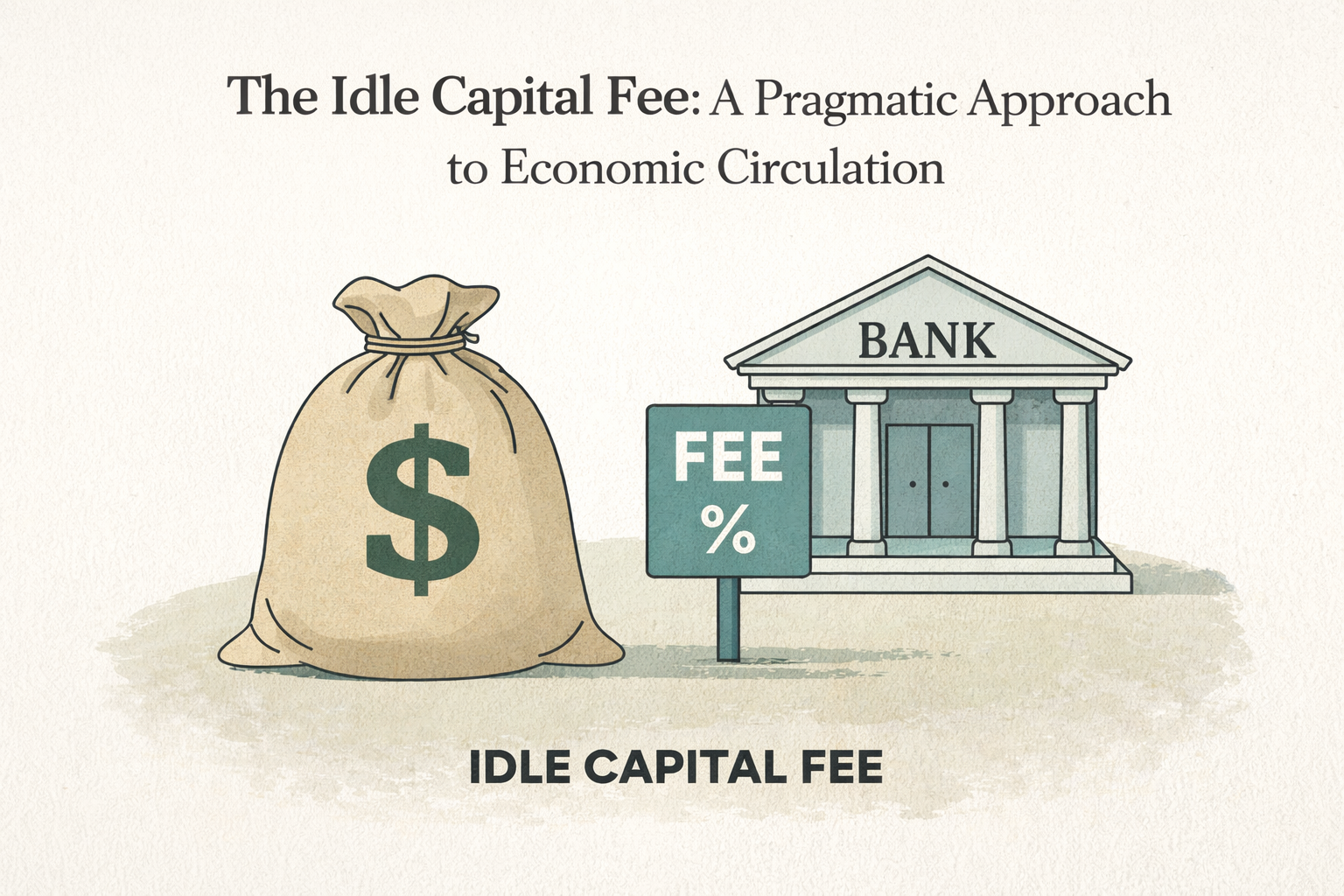
The Idle Capital Fee: A Pragmatic Approach to Economic Circulation
Index
- Introduction
- The Glitch: Taxing the Bees, Not the Honey
- The Dehumanization: The “Make vs. Buy” Calculus
- `The Modern Serfdom: H-1B and the Indentured Servant`
- The Housing Fix: Breaking the REIT Monopoly
- The California Projection: What Happens to Inventory?
- The Revenue Paradox: Won’t This Tank Property Values?
- The Landlord’s Deal: Why Tax the Rent?
- The Classification Guide: 15 Income Types
- The Motive: The Pincer Movement
- The Mechanism: Structural Power & The Law of Erosive Capital
- The Implementation Split: State vs. Federal
- The Proof: The Elites Already Know This (Saudi Case Study)
- The 1913 Legacy Code: Why We Are Stuck
- The Fix: The Idle Capital Fee
- The Legal Battlefield: The “Gold in the Basement” Problem
- The Chokepoint: Don’t Chase the Ghost
- The Billionaire Bill: How Much Would They Pay?
- The Historical Consensus: Smith, Keynes, and the Founders
- The Blind Spot: The Source We Ignored
- Conclusion
1. Introduction
A billionaire who hoards his wealth as gold in a basement is not the same as a billionaire who invests his wealth in machinery and human capital. The former is a drag on the economy; the latter is its engine. Yet, a traditional ‘Wealth Tax’ punishes both equally. This is a strategic error.
We should tax hoarding harshly and exempt production entirely. The ‘Idle Capital Fee’ solves this by distinguishing between ‘dead’ and ‘living’ capital. It surgically targets stagnation to force circulation, creating a narrative that even the most famous billionaires could support—because while it might cost them millions, it rewards them for building rather than hiding.
California is locked in a dangerous game of chicken with its billionaire class. The state wants to levy a 5% wealth tax; the billionaires are threatening to leave. Legally, California is stuck. The U.S. Constitution’s Commerce Clause prevents the state from punishing capital flight, and the Supreme Court looks unkindly on attempts to tax assets held across state lines, despite what Ro Khanna and other proponents of the proposed California wealth tax would argue.
But the impulse behind the tax is correct. We all sense that the current system is broken. The debate, however, is trapped in a useless loop of “Eat the Rich” versus “Don’t Punish Success.”
As an engineer, I don’t see this as a moral problem, I see it as a flow problem. Our tax code is trying to siphon fuel from the engine (income), while letting the fuel in the storage tank (wealth) turn into sludge.
We don’t need a “Wealth Tax.” We need an “Idle Capital Fee“. This prevents taxing speculation and goes after the least useful, most despised form of capital, the “Idle Capital”.
An idle capital tax would not tax the tools of production (farm, data center, lathe, hammers, actively-used buildings/land, etc). These are the “tools of production”, something we want to encourage investment into for a more productive society. A wealth tax is a blunt instrument that taxes productive and unproductive wealth alike, siphoning wealth and cash-flow from the engine that keeps it healthy, rather than surgically targeting the idle capital. It taxes both the billionaire who hoards his wealth in his basement exactly the same as a billionaire who holds his assets in machinery and human capital. One hurts society, one benefits society; one should be taxed, one should not.
2. The Glitch: Taxing the Bees, Not the Honey
The fundamental flaw of the modern American tax system is that it taxes Income rather than Surplus.
In accounting, a factory is allowed to deduct the cost of its maintenance—electricity, repairs, oil—before it declares a profit. It creates a “depreciation schedule” because the machine wears out.
Human beings do not get this same privilege.
When we tax wages, we are taxing the “Human Machinery” on its gross revenue, not its net profit. A worker’s salary is not profit; it is the “cost of maintenance” required to keep that human alive, fed, and housed so they can show up to work tomorrow. By taxing income, the state eats into the survival budget of the worker. We are taxing the bees for the energy they expend to keep the hive alive, rather than taxing the surplus honey.
3. The Dehumanization: The “Make vs. Buy” Calculus
If you view humans strictly as economic units—as the market often does—the current tax code forces a horrifying logical conclusion regarding immigration.
Is immigration bad? No. Organic immigration is healthy. But using immigration to replace a native population that you taxed into sterility is an economic Ponzi scheme.
Every manufacturer faces a classic decision: “Make vs. Buy.”
- “Making” a Worker: To produce a domestic worker takes 18 years of “construction.” Because we tax income so heavily, the “maintenance cost” of raising a child in the West has skyrocketed. Domestic production is now too expensive.
- “Buying” a Worker: An immigrant arrives at the border as a “finished product.” Their construction cost was paid for by another country.
The billionaire class prefers immigration not out of charity, but because it is an arbitrage on human life. Why support tax cuts for families (to lower the cost of “making” citizens) when you can simply “import” cheaper machines that are already built?
4. The Modern Serfdom: H-1B and the Indentured Servant
This cynical approach reaches its peak with the H-1B Visa program.
The pro-business Cato institute narrates that 70,852 H1Bs changed jobs in 2019 out of an estimated total H1B population of approximately 650,000 at the time, estimating a nearly 11% yearly turnover rate within the H1B workforce. According to BLS data, approximately 3 million people are enrolled in the information industry with about 70,000 of them changing jobs on a monthly basis, coming out a yearly industry turnover rate of nearly 30% for the non-H1B information workforce, compared to the nearly 10% turnover rate for the H1B workforce.
The Cato article talks about how often the H1B employees change jobs, but doesn’t compare it to the native population turnover rate, likely for conflict-of-interest related to funding. This line of thinking is used widely to support the H1B status quo, an example is an India Today article that compares the H1B turnover rate not to the native information industry turnover rate, but rather, to the general turnover rate of college graduates, a clear manipulation of the datasets to support a pre-determined narrative.
Corporate lobbyists argue that H-1B is about “attracting talent.” In reality, it is about creating Indentured Servitude.
- The Trap: An H-1B worker’s visa is tied to their employer. If they lose their job, they are deported.
- The Leverage: This creates a class of workers who cannot say no. They cannot negotiate for higher wages. They cannot quit to start a competitor. They are legally “sticky.”
This hurts everyone. It exploits the immigrant (by stripping their freedom) and it hurts the native worker (by suppressing wages with a captive labor force). It is the ultimate efficiency algorithm: importing high-skill machines that are legally forbidden from demanding maintenance costs.
5. The Housing Fix: Breaking the REIT Monopoly
How does this tax affect the housing crisis? Currently, Real Estate Investment Trusts (REITs) and private equity firms are vacuuming up single-family homes, driving prices out of reach for regular families.
The Idle Capital Fee fixes this by distinguishing between Productive Housing and Speculative Hoarding.
- The Rental Property (Exempt): If a REIT owns a home and rents it out, that home is a “Tool of Production.” It is providing a service (shelter). It is exempt from the fee.
- The Vacant Home (Taxed): If a speculator buys 1,000 homes and keeps them empty to artificially constrict supply and drive up prices, those homes are Idle Capital. They are taxed at 2.5% per year.
- The Land Bank (Taxed): If a developer sits on empty land for 20 years waiting for it to appreciate, that is hoarding. It is taxed.
6. The California Projection: What Happens to Inventory?
You might wonder if vacancy is actually a problem big enough to matter. The data says yes.
The Data: California currently has an estimated 1.2 million vacant housing units (Census Bureau). While some are vacation homes or in transition, hundreds of thousands are held off-market for investment purposes.
The Precedent (Vancouver): When Vancouver implemented a similar “Empty Homes Tax” (1%), the number of vacant properties dropped by 26% in the first year alone. Thousands of condos flooded onto the long-term rental market to avoid the fee.
The California Impact: If California applies a 2.5% Idle Fee and sees a similar conversion rate:
- Inventory Surge: Approximately 200,000 to 300,000 homes would immediately hit the market (either for sale or rent).
- Rental Impact: A supply shock of that magnitude would likely freeze or reduce rental prices by 5-10% in high-density areas, as landlords compete to fill units to avoid the tax.
It is a simple lever: The cost of hoarding becomes higher than the cost of renting.
7. The Revenue Paradox: Won’t This Tank Property Values?
A common objection is: “If you force everyone to sell land, property values will drop, and the local government will lose tax revenue.”
This is intuitive, but in California, it is incorrect due to Prop 13.
1. The Prop 13 Basis Reset In California, property tax is based on the purchase price, not the current market value. A “Land Banker” who bought a plot in 1980 for $50,000 pays almost zero tax today, even if the land is worth $2 Million.
- The Scenario: The Idle Capital Fee forces him to sell. He sells it for $1.8 Million (a slight discount because of the flood of supply).
- The Result: The new owner’s tax basis resets to $1.8 Million.
- The Windfall: The local government sees a massive increase in property tax revenue, even if the market price dipped slightly, because a “1980 assessment” was replaced by a “2025 assessment.”
2. Circulation vs. Stagnation Local jurisdictions thrive on Transaction Volume (Transfer Taxes) and Development (Permit Fees). Stagnant land banking kills both. By forcing the land to move, you generate massive revenue from transfer taxes and new construction permits.
So, while the sticker price of the land might drop (making it more affordable for you), the revenue for the city goes up. It is a rare win-win for the working class and the government.
8. The Landlord’s Deal: Why Tax the Rent?
You might ask: “If the rental property is exempt (because it’s a tool), why do we tax the rental income?”
Because the rental income is the Honey.
The goal of the system is to encourage production (the house) but distribute the surplus (the rent). If we exempted the rental income, we would create a feudal landlord class that extracts wealth from the community without contributing to the commons.
- The Exemption: We don’t tax the Value of the House ($1 Million). This encourages you to build and maintain the structure.
- The Tax: We tax the Net Rental Income (The Profit). This ensures that the passive income generated by the asset circulates back into society.
9. The Classification Guide: 15 Income Types
To clear up any confusion: Labor is maintenance (Exempt). Passive Surplus is Honey (Taxed).
| Category | Income Type | Status | The Logic |
| Labor | 1. Wages / Salary | EXEMPT | This is fuel for the human machine. Taxing it hurts reproduction. |
| Labor | 2. Tips / Bonuses | EXEMPT | Reward for direct effort. |
| Housing | 3. Primary Home | EXEMPT | Essential shelter. It is a tool for living. |
| Housing | 4. Rental Income | TAXED | This is “Honey.” The house did the work; you collected the check. |
| Housing | 5. Vacant Land/Home | FEE | 2.5% Idle Fee. You are hoarding a resource. Use it or sell it. |
| Investing | 6. Stocks (Held) | EXEMPT | Ownership of a productive company (active machinery) is exempt. Un-invested company cash-reserves sitting for more than a year would be taxed. |
| Investing | 7. Dividends | TAXED | This is the surplus cash extracted from the company. |
| Investing | 8. Capital Gains | TAXED | If you sell the stock, the profit is realized surplus. |
| Hoarding | 9. Cash Savings | FEE | 2.5% Idle Fee on amounts over a threshold ($50k). |
| Hoarding | 10. Gold / Crypto | FEE | 2.5% Idle Fee. Dead capital sitting in a vault. |
| Business | 11. Business Profit | EXEMPT | If reinvested into the business (machines, wages). |
| Business | 12. Owner Draw | TAXED | If you take the profit out for personal use. |
10. The Motive: The Pincer Movement
Why do elites prefer this demographic and housing shift? Because a shrinking, high-wage middle class is bad for the bottom line. The current strategy offers a “Pincer Movement” of profit:
- Wage Suppression (The Supply Shock): By importing captive “H-1B machinery,” the elite flood the labor market, breaking the bargaining power of the working class.
- Asset Inflation (The Demand Shock): Billionaires hold their wealth in assets (Real Estate). By importing millions of new people, they create artificial demand for housing.
The Result: They pay you less to work (Wage Suppression) and charge you more to live (Rent Inflation). It is the perfect wealth transfer mechanism.
11. The Mechanism: Structural Power & The Law of Erosive Capital
This isn’t necessarily a conspiracy; it is physics. Political scientists call this Structural Power.
Think of Capital as a rushing river and the Tax Code as a canyon. The water doesn’t “decide” to erode a rock; it simply seeks the path of least resistance.
Billionaires possess an “Automatic Veto.” They don’t need to lobby against a tax; they just need to threaten an “Investment Strike.” If the government raises taxes, Capital simply pauses investment. The economy slows, and the politicians get fired. Because the “River of Capital” flows away from costs, the tax burden naturally settles on the only thing that cannot move: You.
The Evolutionary Filter (The “Soup”): Imagine 1,000 random billionaires in 1970.
- Billionaire A is a patriot. He refuses to lobby. He pays his 90% tax. Result: His fortune shrinks. He loses influence. He dies out.
- Billionaire B is purely self-interested. He hires a lobbyist to chip away at a tiny specific regulation that affects only him. Result: He saves money. He uses that money to hire two lobbyists next year. His influence grows.
- The Outcome: You don’t need a conspiracy. Over 50 years, the “Patriot Billionaires” go extinct, and the “Erosive Billionaires” multiply. The class evolves to become a machine that lowers its own taxes, purely through natural selection.
The Entropy Result: Over 50 years, the tax burden naturally “slides” off the slippery class (Capital) and settles onto the sticky class (Labor). It wasn’t a single decision to screw the worker; it was just gravity. The burden settled where it couldn’t move.
Because the tax burden “slid” onto Labor, the cost of being a human (maintenance) skyrocketed.
- The “River” (Billionaire Class) looks at the “Dam” (The Middle Class) and sees that the Dam is too expensive to repair (Native Reproduction).
- So, the River simply flows around the Dam and imports water from a cheaper source (Immigration).
It is a mindless, thermodynamic process of finding the cheapest input. The Billionaires aren’t necessarily “anti-human”; they are just efficiency-seeking algorithms running on autopilot, eroding the expensive parts of society (families) and replacing them with cheaper parts (imported labor).
The solution is to tax the billionaires on what they own, as individuals, not tax shifty organizations that people can hide behind in a never-ending efficiency game. Father of the “Laffer-Curve“, Ibn Khaldun summarized it in the 14th century
“When they [the elite] stop spending, business slumps and commercial profits decline because of the shortage of capital… The dynasty’s tax revenue decreases… and the dynasty disintegrates.” — Ibn Khaldun, The Muqaddimah
Taxing income is a death sentence for civilizations.
12. The Implementation Split: State vs. Federal
Can California do this alone? The answer is a nuance of Physics.
1. Financial Assets (Must be Federal) California cannot effectively tax idle stocks or cash. Money is “slippery.” If California taxes it, billionaires will simply move their legal residence to Nevada. To stop this leak, the tax on financial assets must be Federal, utilizing the IRS’s power of Citizenship-Based Taxation to chase the billionaire wherever they go.
2. Real Estate (Can be State) However, California can unilaterally implement the fee on Vacant Housing and Land. You can move your bank account to Nevada, but you cannot move your apartment building. The asset is immobile. California has the legal authority (Police Power) to regulate land use immediately.
The Strategy: California leads with the Housing/Land Fee (fixing the cost of living), while lobbying Washington for the Federal Financial Fee (fixing the national debt).
13. The Proof: The Elites Already Know This (Saudi Case Study)
The Saudi royal family understands the “Machinery” logic perfectly. They want their native population to grow, so they levy 0% income tax on citizens.
But here is the smoking gun: They do tax children—just not their own. Saudi Arabia imposes a specific “Expat Dependent Fee” on foreign workers.
- The Logic: They artificially inflate the “maintenance cost” of the immigrant machinery.
- The Goal: They want the immigrant to work (produce), but not to breed (settle).
This proves that governments know exactly how Taxing Reproduction = Lower Birth Rates.
Is there proof that this works?
We can look at the “Zero Income Tax” nations for a control group.
The Gulf Cooperation Council (GCC) Model Countries like the United Arab Emirates (UAE), Qatar, Saudi Arabia, and Kuwait levy 0% personal income tax.
- The Philosophy: They tax the resource (Oil/Corporate Profits) but leave the “Human Machinery” alone.
- The Demographic Data: While fertility rates are dropping globally due to modernization, these zero-tax citizens consistently maintain higher family stability and reproduction rates compared to high-tax Asian tigers like South Korea (0.7 fertility rate) or Japan (1.2), where the tax and work burden on the “human machine” is crushing.
By not taxing income, these nations allow heads of households to keep 100% of their “maintenance cost,” making large families financially viable in a way they are not in the West.
14. The 1913 Legacy Code: Why We Are Stuck
It seems baffling that in an era where we have cracked the human genome and landed rockets on boosters, our tax code is so crude.
The reason is that our tax system is running on “Legacy Software” from the Progressive Era. In 1913, when the 16th Amendment (Income Tax) was ratified, it was the high-tech solution. The economy was industrial. Wealth was income. It made sense then.
But just as a 1913 Ford Model T cannot drive on a 2025 Superhighway, a 1913 tax code cannot handle a 2025 Digital Economy.
- The Model T Tax: Targets “Income” (Wages).
- The Tesla Economy: Wealth is generated through “Asset Appreciation” and “Leverage” (Borrowing against assets), which shows $0 income.
We haven’t advanced because of Institutional Inertia. We are trying to patch a century-old operating system rather than upgrading to the scientific solution: taxing the stagnation rather than the effort.
15. The Fix: The Idle Capital Fee
If California wants to fix this, it must abandon the “Net Worth” tax and adopt the “Idle Capital” model.
1. Tax Liquid Assets, Not Speculative Bubbles Don’t tax the stock price of Nvidia. Tax the Net Liquid Assets (Cash/Inventory) on the balance sheet.
2. Exempt the Tools of Production Machinery, factories, and equipment are 100% exempt. If TSMC buys a $300 million lithography machine, they pay zero tax on it. If they sit on $300 million in cash, they pay a 2.5% fee. Invest or Pay.
3. The Investor Incentive
- If you hold $10 million in Gold, you are hoarding. You pay the full fee.
- If you move that $10 million into Stocks (ownership of a business), you get a massive tax break, because the “factory” portion of that business is exempt. You would only pay taxes on the portion of the capital sitting in “cash reserves” for over a year.
| Asset Class: TSMC Stock | Wealth Tax | Idle Capital Fee |
| Market Cap ($4T) | Taxed (Maybe) | Ignored (Fake/Speculative) |
| Machinery ($116B) | Taxed (as part of Net Worth) | EXEMPT (Tools of Production) |
| Liquid Cash ($116B) | Taxed | TAXED (2.5%) |
The tax bill changes from $80 billion to to about $3 billion for this productive company.
Another example, the below table shows the massive different in tax bills between the two methods for a productive company like NVIDIA.
| Tax System | Tax Base | The “Wealth” | Tax Bill |
| Wealth Tax | Market Cap (Stock Price) | $4,000 Billion | $80 Billion (at 2%) |
| Idle Capital Fee | Net Liquid Assets | $90.4 Billion | $2.26 Billion (at 2.5%) |
Note that the “$80 Billion” bill would still apply if a person owned $4 Trillion in gold sitting in a vault somewhere.
This system creates a powerful economic incentive loop
- Hoarding Cash is Expensive: If TSMC sits on $50 billion in cash, it gets eaten by the 2.5% tax every year.
- Investing is Free: If they spend that $50 billion on new machines, the money creates jobs, increases chip supply, and—crucially—vanishes from the tax base.
- Outcome: The tax code forces capital out of the vault and into the factory.
Effectively, this says to TSMC: “We don’t care if you have a $300 million machine that makes the world’s most advanced chips. Keep it. Use it. But if you have $300 million in cash sitting in a bank account doing nothing… a portion of that goes back to societal upkeep”
16. The Legal Battlefield: The “Gold in the Basement” Problem
You might wonder, “If I store gold in my basement and you tax it, isn’t that a Property Tax?”
The Honest Answer: Yes. In reality, it is a tax on your property. The Legal Argument: In court, we must argue it is an Excise Tax on activity.
The U.S. Constitution bans “Direct Taxes” (taxes on ownership) unless they are apportioned by population. To survive, we must frame the Idle Capital Fee not as a tax on having gold, but as a regulatory fee on the act of hoarding it.
- The Argument: “We are taxing the privilege of removing capital from the U.S. economy and storing it in a stagnant state, which burdens interstate commerce.”
17. The Chokepoint: Don’t Chase the Ghost
For decades, we have tried to tax corporations, and we have failed because corporations are “ghosts”—they can move to Ireland with a stroke of a pen.
The Idle Capital Fee ignores the ghost and targets the host. We tax the Individual Shareholder based on their residence. If a billionaire lives in Palo Alto, we tax their portfolio. It doesn’t matter if the company is in Dublin.
18. The Billionaire Bill: How Much Would They Pay?
Critics argue that “Billionaires will never accept this.” But this model is actually a discount compared to a “Wealth Tax.”
Let’s look at Larry Page (Google).
- Net Worth: ~$150 Billion.
- Standard Wealth Tax (2%): $3 Billion/year.
- Idle Capital Fee: Only ~5% of his wealth is backed by idle cash.
- The Fee (2.5%): ~$187 Million/year.
The Verdict: Larry Page saves over $2.8 Billion. The system rewards him for keeping his money in Google (Active) rather than pulling it out into Gold (Idle).
The Liquidity Problem (Asset Rich, Cash Poor) Imagine a farmer who owns land worth $10 million (wealthy on paper) but makes only $50,000 a year in profit (low income).
- If you tax his wealth at 2%, he owes $200,000.
- He only made $50,000.
- To pay the tax, he must sell the farm. This forces people to sell assets just to pay the tax, which can crash markets and kill family businesses.
The Verdict: If the farmer uses those $50,000 to buy food and shelter for his family, then he is not taxed at all because his farm is a tool of production and should not be taxed. He would only pay taxes if he let his money idle in a bank account or other savings asset for more than a year.
Additional Examples:
To understand why this shift matters, let’s look at three different people with three different strategies, and see how the Idle Capital Fee treats them compared to a traditional Wealth Tax.
1. The Dragon (The Hoarder)
- The Person: Robert is a skeptical billionaire. He doesn’t trust the market, so he keeps $100 Million in gold bars and cash in a vault. He employs zero people. He produces nothing.
- The Wealth Tax (2%): He pays $2 Million.
- The Idle Capital Fee (2.5%): He pays $2.5 Million.
- The Verdict: The system punishes him the hardest. He is removing capital from circulation, so he pays the highest premium. The fee eats his hoard until he is forced to invest it.
2. The Builder (The Industrialist)
- The Person: Sarah runs a massive semiconductor factory. Her net worth is also $100 Million, but $80 Million of that is tied up in high-tech robots, clean rooms, and conveyor belts. She only keeps $20 Million in cash and inventory to pay her 500 workers.
- The Wealth Tax (2%): She pays $2 Million. (Punished for having expensive machines).
- The Idle Capital Fee (2.5%): She pays roughly $500,000.
- The Verdict: Sarah pays 75% less tax than Robert, even though they are equally “rich.” Why? Because her wealth is working. Her “bees” (machines) are exempt. The system rewards her for building infrastructure and creating jobs.
3. The Dreamer (The Startup Founder)
- The Person: David founded a tech startup. The stock market went crazy and says his company is worth $1 Billion on paper. But David hasn’t sold any stock. He lives in a rented apartment and draws a modest salary.
- The Wealth Tax (2%): He owes $20 Million in cash. He doesn’t have $20 million. He is forced to sell control of his company to Wall Street just to pay the tax bill.
- The Idle Capital Fee: He pays $0 on the stock valuation. He is only taxed on his personal savings if they exceed the threshold.
- The Verdict: David keeps his company. The system recognizes that “Paper Wealth” isn’t real money until he sells it. He isn’t forced to liquidate his dream to satisfy a tax on imaginary gains.
If you hold $10 million in Gold, you are hoarding. You pay the full fee. If you move that $10 million into Stocks (ownership of a business), you effectively get a massive tax break, because the “factory” portion of that business is exempt from the tax base.
The Math: Gold vs. Stocks
Let’s say you have $1 Million to park somewhere.
Scenario A: You buy Gold Bars
- Asset Class: Pure “Currency” / Hoarded Wealth.
- Exemptions: None.
- Tax Base: $1,000,000.
- The Fee (2.5%): $25,000 per year.
Scenario B: You buy stock in a Manufacturing Company (e.g., Ford or TSMC)
- Asset Class: “Business Ownership.”
- Exemptions: You are allowed to deduct the “Tools of Production” (factories, robots, land, patents).
- The Reality: For a heavy manufacturer, 70-80% of their value might be in machines and buildings. Only 20-30% is in “Liquid Assets” (Cash/Inventory).
- Tax Base: ~$250,000 (The liquid portion of your share).
- The Fee (2.5%): $6,250 per year.
The Result: A 75% Tax Cut
By moving your money from gold to the factory, you lowered your tax bill from $25,000 to $6,250.
Why does the system do this?
It goes back to the “Idle Capital” philosophy.
- Gold is Lazy: Gold sits in a safe. It employs no one. It produces nothing. It is “dead” capital. The high tax punishes you for keeping capital dead.
- Stocks are Active: When you buy stock, you are funding a company. That company employs workers, buys raw materials, and produces goods. The system rewards you for taking on risk and fueling the economy by exempting the “machinery” part of your investment.
The “Trader” Trap (Important Distinction)
There is one catch. This tax break only applies if you are an Investor (holding for dividends/long-term growth).
If you are a Day Trader (flipping stocks for quick profit):
- The stocks are treated as Merchandise (Inventory on a shelf).
- Result: You pay 2.5% on the full market value ($1 Million), just like the gold.
So, the system incentivizes two specific behaviors:
- Invest, don’t hoard. (Buy stocks, not gold).
- Commit, don’t speculate. (Be a long-term owner, not a flipper).
19. The Historical Consensus: Smith, Keynes, and the Founders
This idea aligns with the foundational principles of history’s greatest economic thinkers.
Adam Smith despised “idle capital”, hoarded resources.
Ground-rents and the ordinary rent of land are a species of revenue which the owner, in many cases, enjoys without any care or attention of his own… Ground-rents seem, in this respect, a more proper subject of peculiar taxation.
John Maynard Keynes feared the “Liquidity Trap” (hoarding) and argued the state must discourage it.
“The absurd, though almost universal, idea that an act of individual saving is just as good for effective demand as an act of individual consumption, has been fostered by the fallacy… that the owner of wealth desires a capital-asset as such, whereas what he really desires is its prospective yield.” — John Maynard Keynes
Even The Physiocrats of 18th-century France coined the concept: “Tax the honey, not the bees.”
20. The Blind Spot: The Source We Ignored
Countries like France ignored this pre-existing concept for various reasons, when they implemented a wealth tax, roughly 42,000 millionaires left the country between 2000 and 2012. They moved to Belgium or Switzerland. France lost more money in lost income tax (from rich people leaving) than they gained from the wealth tax. This is the exact threat California faces now.
The Old French Tax (ISF – Impôt de Solidarité sur la Fortune):
- What they did: They taxed everything. If you had $10 million, whether it was in cash, a factory, or shares in a startup, you paid ~1.5% every year.
- The Result: It punished “The Builder” and “The Founder.” Entrepreneurs couldn’t pay the tax without selling their own companies. Roughly 42,000 millionaires left France.
- The Repeal: President Macron killed it in 2018.
The New French Tax (IFI – Impôt sur la Fortune Immobilière):
- The Fix: Macron replaced it with a tax only on Real Estate.
- The Logic: You can move your cash to Belgium, but you can’t move your Château.
- The Problem: It effectively lets billionaires off the hook if they hoard cash or stocks, as long as they don’t buy houses.
The man who codified the “Idle Capital Fee” is none other than Muhammad, who was a Merchant who managed caravans; understood risk, liquidity, and payroll. This is a tax code written by a businessman for businessmen, designed to keep markets moving.
The resistance to trying this model is ironic because the US Supreme Court features a frieze of the 18 greatest lawgivers of history, including The Prophet Muhammad. The Founders recognized him as a source of legal wisdom. We are happy to put his statue on the wall, but we refuse to read the ideas he brought.
21. Conclusion
We need to rebrand the conversation. “Wealth Tax” sounds like the government is seizing your grandmother’s ring. The Idle Capital Fee is different. It is a penalty for stagnation.
By refusing to study successful models from history due to cultural isolationism, the West has backed itself into a corner, taxing the labor that keeps the native species healthy and reproducing, while subsidizing the hoarding that hurts the native population it tries to protect.
The Idle Capital Fee is different. It is a penalty for stagnation. It tells the billionaire: “We don’t mind that you are rich. We mind that your money is sitting still.”